Sep 2026
|Published By Marino Marks




What GEO actually means for your business, and whether it deserves a dollar of your budget.
Someone asked me recently whether generative engine optimization was a real thing or just the next acronym agencies invented to sell a retainer. Fair question. They had been pitched three times that quarter, each pitch heavier on buzzwords than the last.
Here is what is true about it, what is hype, and how to decide whether it deserves a dollar of your budget. My background is in email and lifecycle marketing, but for years I have kept a close eye on SEO and search behavior because I am a big believer in omnichannel marketing. The two have always been connected. I have seen this pattern before. A new channel appears, the hype outruns the reality, and the businesses that quietly focus on the fundamentals win.
Generative engine optimization is the practice of shaping how AI answer engines mention, summarize, and cite your brand when a buyer asks them a question in your category. That is it. When someone asks ChatGPT for a good commercial law firm in Markham, GEO is the work that influences whether your name is in the answer.
Now let me tell you what it is not.
It is not a secret algorithm you can game. It is not a replacement for SEO. And it is not a guaranteed path to being “the answer” that AI tools spit out. Anyone framing it that way is selling you something.
The real question you are asking is not academic. It is this: when a buyer asks an AI tool who they should hire in my category, do I show up, and can I do anything about it? That is the question worth answering. Everything else is decoration.
This is what generative engine optimization really means for a mid-market brand: it is not a nice-to-have layer you add once your other marketing is running smoothly. A brand with no presence in that picture today is not just missing out on citations now. As competitors build stronger content, more third-party corroboration, and a longer track record of clear, quotable answers, the bar for earning visibility is likely to keep rising. If AEO and GEO are not part of your marketing now, the advantage of starting early, while that bar is still relatively low, is one you will not get back.
It matters because your buyers have started their research inside AI tools instead of scrolling ten blue links, and an AI answer that names a competitor instead of you is a qualified lead you never see. Mid-market brands sit in the exposed middle: enough content to compete on specific questions, not enough authority to win by default.
The scale of this shift is no longer a guess. Google has said its AI Overviews now reach more than 1.5 billion users a month (Google, The Keyword, May 2025), and OpenAI reported more than 800 million weekly ChatGPT users at its DevDay 2025 event (OpenAI, DevDay 2025). That is not a niche behavior anymore. That is a meaningful share of how your buyers start their research.
Think about how the behavior has changed. A buyer used to type a query, scan a page of links, and click around. Now a growing share ask an assistant a direct question and read a synthesized answer. Sometimes they click through. Often they do not. Pew Research Center found that when a Google AI summary appears, users click a traditional search result only about 8% of the time, compared to 15% when no AI summary is shown, and only about 1% ever click a link inside the AI summary itself (Pew Research Center, July 2025).
That changes what visibility even means. The old measure was clicks to your site. The new measure is whether you are mentioned inside the answer at all.
Here is where mid-market brands get squeezed in my opinion. National names often have an advantage because they have substantially more corroborating information and authority signals across the web. You do not have that gravity. But you also have something a tiny local competitor does not: enough real content and credibility to compete for the specific, high-intent questions that actually convert.
That is the opening. And it ties straight back to revenue. If a prospect asks an AI tool for a recommendation and your competitor’s name comes up, that prospect may never search again. They got their answer. You never entered the room.
This is the part most GEO content skips, because it is easier to explain the concept than to price out the cost of doing nothing. So let me be direct about what is actually at stake for a mid-market business right now.
The competitive gap is still small, and that will not last. Most mid-market categories have not been claimed yet. The businesses actively shaping how AI tools describe them are still mostly national brands and a handful of early movers. That means a mid-market brand that gets its fundamentals right now, clear service pages, consistent facts, real third-party corroboration, has a real shot at earning strong visibility across the prompts that matter in its category. Wait two or three years, once every competitor has run this playbook, and that same work buys you far less.
Every unanswered question is a lead handed to a competitor. When a buyer asks an AI tool who to hire and your competitor’s name comes up instead of yours, you did not lose a click. You lost the entire conversation. If the prospect completes that part of their research inside an AI interface, you may never see the interaction in your analytics or get the chance to influence that stage of the journey directly. That is revenue leaving the table with no visibility into it happening.
Trust compounds differently in an AI answer than it does on a search results page. A buyer scanning ten blue links still has to do their own evaluating. A buyer reading a single AI-generated answer that names your business alongside a clear, specific description of what you do is closer to being sold before they ever reach your site. Being cited well is a credibility shortcut that traditional SEO rankings never fully offered.
The fix does not require a new budget line, it requires better discipline with the one you already have. Nothing in the practical starting point below is exotic. It is the same clarity, accuracy, and proof that should already be on your site and in your marketing. GEO does not ask a mid-market brand to out-spend a national competitor. It asks you to be more specific and more corroborated than they are, which is a fair fight a smaller, focused business can actually win.
The honest summary: doing nothing does not keep you neutral. Your competitor’s content is already being read by these systems whether you participate or not, and every month you wait is a month a competitor’s clearer, more specific answer gets baked further into how AI tools describe your category.
SEO optimizes your pages to rank in a list of links. GEO optimizes your content to get pulled into a synthesized answer. The overlap is large: strong content, clean structure, and real authority do the heavy lifting for both. The difference is that AI answer systems consistently favor clarity, quotability, and claims corroborated across multiple credible sources.
There is no universally accepted boundary between AEO and GEO. Some practitioners treat AEO as the broader category and GEO as a subset, others reverse it, and others use the terms almost interchangeably. The distinction below is the one we find most useful operationally, not an industry standard.
| Traditional SEO | Generative Engine Optimization (GEO) | Answer Engine Optimization (AEO) | |
|---|---|---|---|
| Goal | Rank in a list of links | Get pulled into a synthesized AI answer | Get selected as a direct spoken or featured answer |
| Success signal | Position and click-through rate | Citation, mention, and share of AI answer | Direct answer selection (voice, featured snippet, AI summary) |
| Content style | Keyword-optimized pages | Clear, quotable, self-contained statements | Concise, question-and-answer formatted content |
| Proof it works | Backlinks, domain authority | Third-party corroboration, clear structure | Structured markup, FAQ formatting |
| Where it is used | Google, Bing organic results | ChatGPT, Perplexity, Google AI Overviews, Gemini | Voice assistants, featured snippets, AI Overviews |
In practice, most teams treat AEO and GEO as the same discipline with different names, since both reward direct, structured, citable answers. The distinction that matters more is geo vs seo: SEO gets you found, GEO gets you quoted.
Let me make the difference concrete.
Traditional SEO cares about ranking position for a keyword. GEO cares about whether a model can lift a clean, unambiguous statement from your page and trust it enough to repeat it.
Picture two law firm pages.
An AI model can quote the first page. It states who the firm serves, where, and how, in plain language. The second page says nothing a model can use. When a buyer asks for a GTA construction litigation firm, guess which one is more likely to surface.
That is the shift. Modern SEO has already moved toward rewarding useful, intent-matching content over vague, keyword-padded pages. GEO raises the cost of vagueness further, because the system needs information it can understand and reuse directly, not just rank. The clearer and more specific you are, the more useful you become to a machine trying to answer a real question. Good SEO and good AI optimization pull in the same direction. They just reward precision at different levels.
Academic research backs this up. One of the foundational GEO studies, out of Princeton, Georgia Tech, and other institutions, found that applying techniques like adding citations and quotable statistics produced visibility gains of up to 40% in its experimental generative-engine environment, though results varied significantly by query type and optimization technique (Aggarwal et al., “GEO: Generative Engine Optimization,” arXiv, 2023). It is a controlled study, not a live measurement of ChatGPT or Google AI Overviews today, but it is real evidence that this kind of clarity and corroboration moves the needle.
As lead author Pranjal Aggarwal and his co-authors put it in the paper that coined the term: “Generative Engine Optimization (GEO) [is] the first novel paradigm to aid content creators in improving the visibility of their content in Generative Engine responses.” That is a useful reminder of what GEO actually is at its root: a research-backed content discipline, not a marketing buzzword invented to sell a retainer.
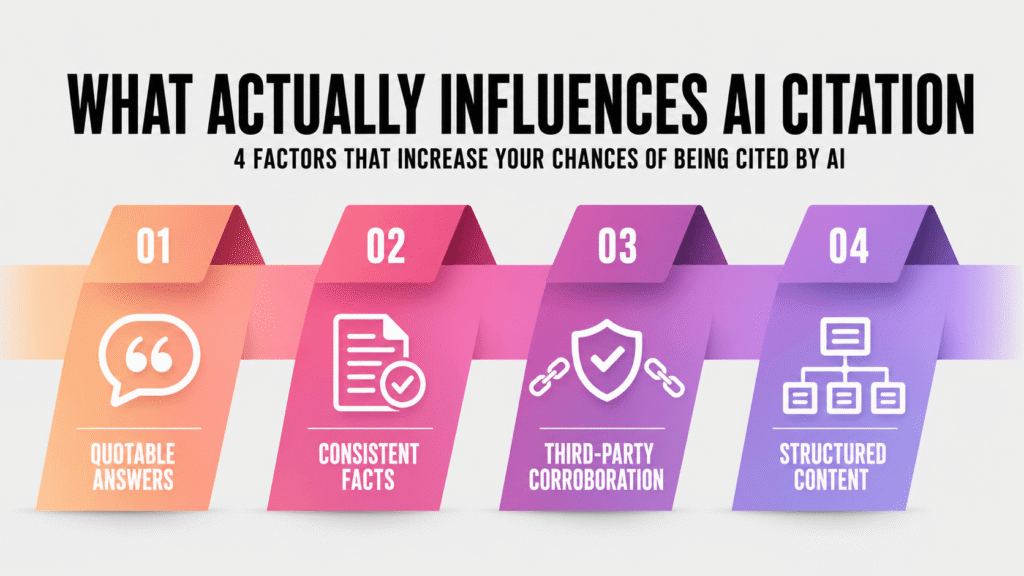
AI tools are more likely to cite you when your content answers specific buyer questions in language that can be lifted cleanly, when your brand facts are consistent everywhere, and when credible third parties already reference you. There are no guaranteed levers here. The systems are opaque and change often, so this is about improving odds.
The factors that seem to move the needle:
This is also where LLM optimization and AI visibility overlap with plain good marketing. HubSpot’s 2025 survey of over 1,500 marketers found that roughly two-thirds now use AI in their role. Separately, HubSpot has also reported that 31% of Gen Z respondents say they start their queries in AI or chat-based tools rather than a traditional search engine (HubSpot, AI Trends for Marketers, 2025). Different findings, same direction: a real and growing share of your buyer pool is forming an opinion of you before they ever land on your site.
Now the honest part in my view. Nobody outside the AI companies knows the exact weighting, and it changes. So treat every one of these as an odds-improver, not a switch. Anyone selling certainty here is guessing with confidence.
Start by auditing what AI tools already say about your category, fix your fundamentals, strengthen third-party corroboration, keep SEO running, and measure the right things. You do not need a massive new program. You need to point existing good-marketing discipline at a new surface, in the right order.
Here is the sequence I would use:
Adobe Analytics has tracked a sharp year-over-year rise in AI-referral traffic to US retail sites, confirming that buyers are increasingly clicking through from AI tools when the content earns it (Adobe, “The Explosive Rise of Generative AI Referral Traffic”). Traffic from these tools is smaller than traditional search today, but it is growing from a real base, not a hypothetical one.
Done in that order, GEO is precise and affordable. Done backwards, it is an expensive process.
Be skeptical of anyone promising guaranteed placement in AI answers, anyone treating GEO as keyword stuffing 2.0, and anyone pushing you to over-invest before your fundamentals are solid. GEO rewards the same things good marketing always has: clarity, accuracy, and credibility, applied with more precision.
The warning signs:
Reframe it this way. GEO is not a strange new discipline that threatens everything you know. It rewards clear writing, honest positioning, accurate facts, and real credibility. You have always needed those. Now they show up in one more place your buyers look.
Before you invest in any of this, talk to our team and find out where you stand. We will show you where your brand shows up in AI answers today, and where it does not, so you know exactly what is worth fixing first.
No. SEO still drives traffic from traditional search, and much of what earns you strong SEO also helps AI tools cite you. GEO is an added layer focused on how AI answer engines summarize and mention your brand, not a swap for search work you already need.
GEO focuses on getting cited or mentioned inside AI-generated answers from tools like ChatGPT and Google AI Overviews. AEO, or answer engine optimization, is the closely related practice of structuring content so it can be pulled directly into a featured snippet or spoken answer. In practice, both reward the same thing: clear, direct, well-structured answers to specific questions.
No, and anyone who promises that is selling you something. AI systems are opaque and change constantly. You can improve your odds by publishing clear, accurate, quotable content and building credible third-party corroboration, but citation cannot be guaranteed.
You track whether your brand gets named in AI answers for the questions your buyers ask, how often, and whether it ties to qualified leads and revenue. Some traffic still lands on your site from AI referrals, but the bigger signal is being present and correctly represented in the answer itself.
It matters for mid-market brands especially. National names often get named by default. A mid-market firm can win specific, high-intent questions, like a category plus a location, by being the clearest, best-corroborated source for that narrow query.
Open the AI tools your buyers use and ask them the questions your prospects ask. Note who gets recommended. That gap between where you show up and where you do not tells you exactly what to fix first.