Jul 2026
|Published By George Arabian




I’ve watched this movie before. A new ad platform launches, marketers grab their existing playbook, port it over wholesale, and burn six months of budget learning the hard way that the new channel plays by different rules. It happened with Meta. It happened with TikTok. Now it’s happening with ChatGPT ads, and I want to save you the tuition.
Here’s my stake in this. We’re running ChatGPT ads right now, live campaigns, real budget, testing performance as I write this. The platform is live in Canada, and OpenAI is moving fast. Ads started testing in the US on February 9, 2026, the self-serve Ads Manager opened in May with no minimum spend, and Reuters reported over $100 million in ad revenue in the first six weeks of the pilot alone. OpenAI is targeting $2.5 billion this year with a stated ambition of $100 billion by 2030. The UK, Mexico, Brazil, Japan, and South Korea are next in line.
So this channel is real, the auction is live, and Canadian advertisers can buy in today. The question is not whether you should pay attention. The question is whether you approach it as a second search network or as something structurally different. After weeks inside the platform, I’m firmly in the second camp, and the mechanics back me up.
The entire Google Ads machine is built on one beautiful, simple signal: a human typed words into a box. That keyword is declared intent. You bid on it, you match your ad to it, you mine your search query reports, you add negatives, and you tighten the loop month after month. Twenty-five years of paid search practice sits on top of that single mechanic.
ChatGPT ads have no keyword. According to OpenAI’s own documentation, ads are matched to the topic of the current conversation, the user’s past chats, and their past interactions with ads. You are bidding into a conversation, not a query. Intent is inferred from conversational context, and here’s the part most marketers haven’t absorbed yet, you will never see that context. OpenAI does not share prompt content with advertisers. You get aggregated views and clicks, nothing more.
I can confirm this from the inside. There is no search query report to pull. There are no negatives to add. The first thing our team looked for in Ads Manager was the query-level view we’d lean on in any Google account, and it does not exist by design. The optimization loop that made Google Ads manageable is gone. Anyone selling you “keyword strategy for ChatGPT ads” is selling you a map of a country that doesn’t exist.
ChatGPT Ads and Google Ads look similar on the surface, but the underlying mechanics reward completely different strategies.
| Dimension | Google Ads | ChatGPT Ads |
|---|---|---|
| Intent signal | Declared intent (keyword typed into a box) | Inferred intent (conversation topic, past chats, past ad interactions) |
| Keywords / targeting data | Search query reports, negatives, keyword bidding | No keywords, no query reports, no negatives by design |
| Ad placement | Above the organic results, before the user reads | Below the finished answer, labelled and visually separated |
| Auction and cost | Keyword auction | Relevance-weighted second-price; about $3 to $5 CPC, $25 to $60 CPM |
| Measurement | Pre-click query data plus post-click | No pre-click data; Conversions API into CRM, judged on pipeline and revenue |
| Audience reached | All searchers | Only Free and Go tier users (paid tiers stay ad-free) |
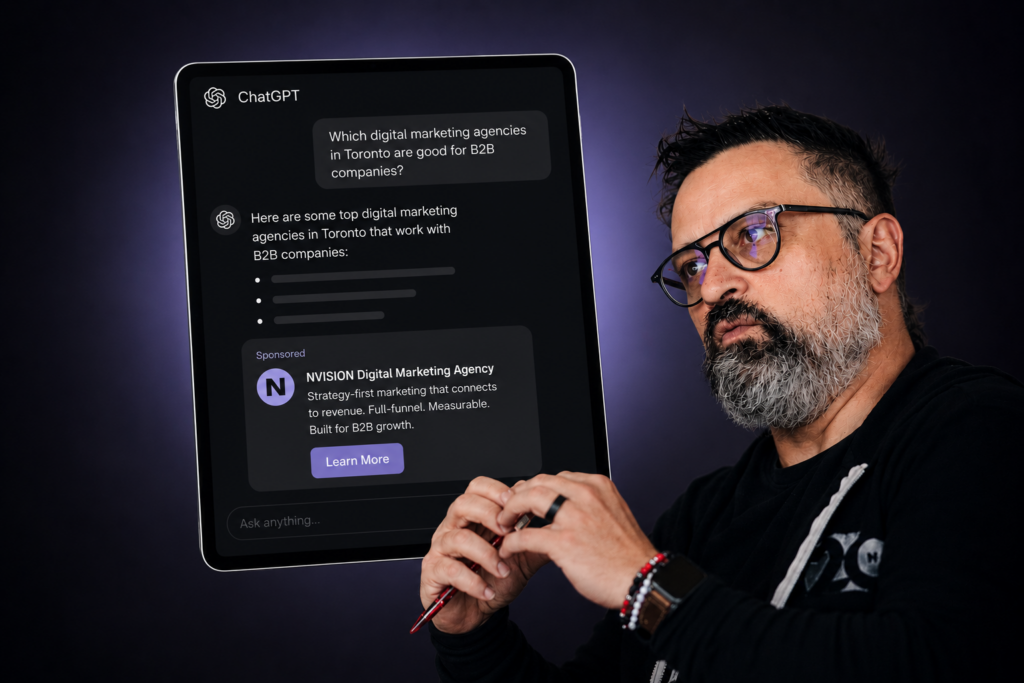
Here’s the structural difference that matters most. On Google, your ad sits above the organic results, competing for attention before the user reads anything else. In ChatGPT, the ad appears below the answer, clearly labelled, visually separated, and by OpenAI’s design, the ad never influences what the answer says.
Sit with that for a second. The user asks ChatGPT to compare digital marketing agencies in Toronto. ChatGPT gives a complete, synthesized recommendation. Then, underneath that finished answer, your ad appears. If the organic answer named your competitor, your ad is a consolation prize that shows up after the decision has been made.
This flips the paid and organic relationship on its head. In search, paid could compensate for weak organic rankings. In conversational AI, the organic answer does the heavy lifting, and paid is the supplement. The real battleground is whether the model cites you inside the answer itself. That’s an AI visibility problem, not a media buying problem, and it’s won with structured content, consistent entity data, and authority signals, not with a higher bid. We treated our own AI visibility as the prerequisite before spending a dollar on placement, and I’d tell any client to sequence it the same way.
There’s good news for mid-market advertisers buried in the mechanics. The ChatGPT ads auction is relevance-weighted and second-price, which means a tightly matched creative on a smaller bid can beat a lazy big-budget ad. Early market data puts CPC bidding at roughly $3 to $5 per click and CPMs in the $25 to $60 range, down from the flat $60 of the pilot phase.
OpenAI launched with the big holding companies, Dentsu, Omnicom, Publicis, and WPP, as partners. However, the removal of minimum spend requirements means you’re competing on relevance and creative quality, not on agency retainer size. That rewards advertisers who understand their buyer’s decision process deeply enough to write creative that helps someone decide, not creative engineered to harvest a click. Different skill, different discipline, and in our early testing it’s the variable we’re spending the most time on.
Get in touch with our experts for a free consultation and kick start your growth
Measurement is where the Google Ads habits will hurt you most. ChatGPT ads ship with a Conversions API, so you can tie post-click events like signups, purchases, and demos back to the ad. That’s genuinely useful. But remember, you have no pre-click intent data. You can’t segment performance by query theme because there are no queries. All the analytical weight moves to the post-click side.
This is exactly how we’ve wired our own test. Every ChatGPT-attributed click flows into our CRM, and we’re judging the channel on cost per opportunity and cost per closed deal, not cost per click. It’s early, and I’ll share numbers when they mean something. What I can tell you now is that platform dashboards flatter themselves on every channel ever built. The gap between dashboard wins and bank wins is where ad budgets go to die, and on a channel this young, that gap will be wider than you’re used to.
One more fact that changes B2B math specifically. Ads only appear for users on the Free and Go tiers. Plus, Pro, Business, Enterprise, and Education accounts stay ad-free. If your ideal buyer is a power user paying for ChatGPT at work, they may never see your ad at all. The headline number of 2.5 billion daily prompts is real, but your reachable slice of it is narrower than the press coverage suggests. Factor that into forecasts before you promise your CFO anything.
ChatGPT ads deserve a place in your 2026 planning, but not as a clone of your search program. The sequencing matters, and it’s the sequence we followed ourselves. First, invest in AI visibility so the models cite you organically, because the answer shapes the decision before any ad renders. Second, wire your measurement, Conversions API into CRM, judged on pipeline and revenue. Third, test paid with creative built for someone mid-decision, not mid-scroll. Strategy before execution, in that order.
The platforms will keep changing. The principal won’t. Marketing that connects to revenue starts with understanding how your buyer decides, and on this channel, the buyer decides inside the conversation. Meet them there first.
Looking for a digital marketing agency that is testing ChatGPT ads with real budget instead of theorizing about them? Book a strategy call with NVISION and we’ll map where ChatGPT ads fit your pipeline in real time.
For more straight talk on marketing, business growth, and what actually drives revenue, follow me on LinkedIn. I share what I’m seeing in the trenches every week.