Jun 2026
|Published By George Arabian
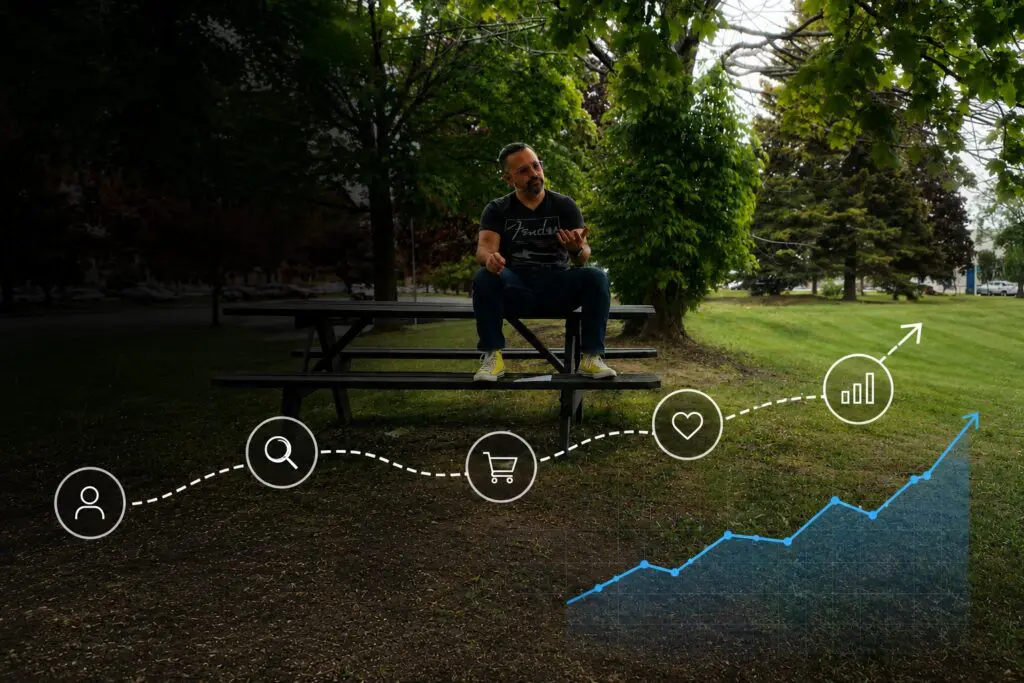




Most business owners can tell me their traffic numbers. Very few can tell me what that traffic is worth in dollars. That gap is where revenue quietly disappears.
When you map the customer journey the right way, you stop guessing and start forecasting. You see where a prospect speeds up, where they stall, and where they walk away for good. Then you can put a number on each stage and predict revenue growth before it ever shows up in the bank.
This is the work behind every claim I make about marketing connecting to revenue. Here is how we do it.
Plenty of teams already have a customer journey map. Most of them are decoration.
They map activity, not money. A slide with tidy arrows running from “awareness” to “purchase” looks great in a deck. It tells you nothing about where the revenue leaks. Honestly, if a map cannot point to a dollar figure, it is art, not strategy.
The fix is to treat the journey as a financial system. Every stage has a conversion rate. Every conversion rate has a cost when it slips. Once you see the journey that way, the map starts paying for itself.
We run a simple three-step method on every client. Map the journey. Diagnose the friction. Engineer the revenue.
That method sits on top of our Golden Funnel, which is the journey itself: Attention, Trust, Pipeline, Revenue. Four stages, one repeatable method. Let me walk you through each step.
Start by laying out the real path end to end. Not the path you wish people took. The one they actually walk.
Attention is the first touch, an ad, a search result, a podcast mention, a referral. Trust is everything that happens once they land, the website, the proof, the offer, the speed. Pipeline is the moment they raise a hand and become a lead. Revenue is the close.
Now write down the conversion rate between each stage. Visitors to leads. Leads to opportunities. Opportunities to closed deals. You finally have a baseline. Most companies have never seen these numbers lined up in one place, and the first look stings a little.
With the map in front of you, the leaks become obvious.
Maybe Attention is strong but Trust collapses. That means your traffic is fine and your website is the problem. Maybe Trust holds but Pipeline stays thin. That means your offer is weak or your lead routing is broken. Each drop-off points to one specific, fixable issue.
Here is where website optimization and lead quality stop being separate conversations. A slow landing page and a poorly qualified lead are the same disease showing up at different stages. The map tells you which one is bleeding more money right now.
Now comes the math that changes the conversation.
Take your worst-performing stage. Model what a realistic improvement does downstream. If you move visitor-to-lead from 2% to 3%, how many more opportunities appear? How many more of those close? What is that worth across a full year?
That number is your forecast. It is not a wish. It is a calculation built on your own conversion data. When you fix the friction, the revenue lands right where the model said it would. Ultimately, that is the whole difference between hoping and predicting.
A client comes to me convinced they need more traffic. We map the customer journey and find their Attention stage is already strong. The real leak sits between Trust and Pipeline, where a clunky form and a vague offer bleed out two-thirds of their interested visitors.
More traffic would have poured water into a leaking bucket. Fixing the form and sharpening the offer lifted that same traffic into far more revenue. I covered why more leads are rarely the answer in a separate piece, and this method is the mechanism behind it.
This is not a one-time exercise. Markets shift, pages age, and offers go stale.
Map the journey at the start. Diagnose the new friction every quarter. Engineer the next fix and watch the forecast move. Each pass tightens the system, and a tighter system compounds. That compounding is what separates steady growth from a lucky month.
You cannot predict revenue growth from a dashboard full of vanity metrics. You predict it by treating the customer journey as a financial system, finding the friction, and engineering the fix.
Map, Diagnose, Engineer. Run it across every stage from Attention to Revenue, and your forecast stops being a guess. It becomes a number you can build a business on.
In the next piece, I break down the specific friction points that cost the most between a click and a customer.
Looking for a digital marketing agency that will map your customer journey to revenue instead of chasing vanity metrics? Book a strategy call with NVISION and we’ll diagnose where your revenue is leaking in real time.
For more straight talk on marketing, business growth, and what actually drives revenue, follow me on LinkedIn. I share what I’m seeing in the trenches every week.