Why Do Marketing Campaigns Fail?


Listen on:



Share:
There is one question that tells you whether your marketing is producing revenue or burning cash. Most businesses have never asked it.
Instead, they buy ads. They hire agencies. They change platforms. They add channels. But they skip this one important question. And that is where their money disappears.
My name is George Arabian and I have been helping businesses turn marketing into a revenue-producing system for over 20 years across thousands of engagements and hundreds of organizations, including Forbes Agency Council.
When businesses ask me to look at their marketing, the pattern is the same almost every time: they start spending before they understand the size of the opportunity. And that one mistake creates a bunch of problems.
That’s because you end up measuring the wrong things. You chase traffic instead of revenue. Your teams fall out of alignment. Your economics break.
Every one of those is a sign of the same problem. It all goes back to that question.
This blog will show you what that question is, how it connects to every reason marketing fails, and what to do to turn your marketing into a revenue system once you have the answer.
We’re Built for Business Owners LIKE YOU
Get in touch with our experts for a free consultation and kick start your growth
Why Marketing Can Fail
Problem #1: You don’t define the size of the opportunity before you spend
When I was seven, I sold boondoggle bracelets on a playground for a quarter each during recess. Not every kid wanted one and not every kid had a quarter.
If I wanted to make some money that day, the question was never about how big the playground was. It was how many can I realistically sell before the bell rings.
That is the question most businesses skip. Before a single ad runs, someone needs to answer: is this a real opportunity, or just an interesting idea?
When you actually sit down and look at the numbers, you find out fast. The audience is too small. The geography is wrong. Nobody is searching for what you sell.
That’s why if you skip that step and you spend money in markets you cannot service, bring in leads you cannot close, and then blame marketing for the results.
The problem was never the marketing. It was the question you did not ask.
Problem #2: You confuse marketing activity with revenue growth
Most teams confuse activity with growth because they measure output. The more we do, the thinking goes, the better the results will be. More posts. More ads. More channels. More campaigns.
But all that output does not mean anything if it is not producing revenue. Activity is just motion. And when you have not sized the opportunity first, there is no way to know whether that motion is pointed in the right direction.
Problem #3: You measure output instead of outcomes
Look at your last marketing report.
Does it tell you how many impressions became qualified leads?
How many of those leads became sales conversations?
How much revenue those conversations produced?
If it cannot connect those dots, you are looking at big numbers that do not mean anything. That is where the money goes.
It goes back to not knowing how big your market actually is. Without that number, you cannot tell whether the volume you are generating matters at all.
Problem #4: You run inconsistent cadences, so performance becomes chaotic
Teams guess at market size, who is actually going to buy, and how much competition they are up against. Then they are surprised when performance feels chaotic. Marketing that runs in bursts produces data that looks like noise, because it is noise.
Consistency gives you a baseline. A baseline lets you see what is working. Without one, every decision is a guess. And if you never sized the opportunity, you do not even know what a good baseline looks like.
Problem #5: You don’t assess your market size
This is where the playground lesson applies at scale. There are three lenses that size your opportunity.
TAM is your total addressable market. If you sell accounting software to small businesses in Ontario, TAM is every small business in Ontario that could theoretically buy accounting software. It is the whole playground.
SAM is your serviceable addressable market. Out of that total, how many can you actually reach given your budget, your sales team, and your channels? If you only have two sales reps and a $5,000 monthly ad budget, you are not reaching all of Ontario. SAM is your side of the playground during recess.
SOM is your serviceable obtainable market. Out of those you can reach, how many can you realistically win given your competition and how good your team is at closing? SOM is how many bracelets you can actually sell before the bell rings.
Most organizations build plans based on TAM, forecast based on SAM, and execute in a world governed by SOM. The gap between those is where capital disappears.
If you do not know your SOM, every dollar you spend on marketing is a guess, and that is the question most businesses never ask.
Why Marketing Doesn’t Generate Revenue for Some Businesses
Problem #6: You chase vanity metrics instead of building toward profitable revenue
Every organization I have worked with engages with marketing for one reason: revenue. But somewhere between that intent and the execution, the focus drifts to metrics that feel good but do not pay the bills.
When I was selling bracelets, the metric that mattered was quarters in my pocket, not how many kids walked past my table.
If your marketing report looks good but your revenue does not reflect it, the report is measuring the wrong things. And the wrong measurements compound every month you do not correct them.
What to measure if you want revenue (not just activity)
| Category | Vanity metrics (misleading) | Revenue metrics (what matters) | Why it matters |
|---|---|---|---|
| Traffic | Impressions, clicks | Qualified visitors | Not all traffic converts |
| Leads | Total leads | Sales-qualified leads (SQLs) | Volume ≠ quality |
| Conversion | Form submissions | Lead-to-customer rate | Measures real effectiveness |
| Sales | Opportunities created | Close rate | Shows alignment with sales |
| Revenue | Pipeline value | Revenue generated | Actual business impact |
| Economics | Cost per click | Customer acquisition cost (CAC) | True cost of growth |
| Profitability | None tracked | Lifetime value (LTV) vs CAC | Determines scalability |
| Time | Campaign activity | Time to close | Impacts cash flow |
Problem #7: You focus on traffic but ignore conversion and unit economics
Traffic makes everything louder. If your system is broken, more traffic just means more waste. If your economics do not work, more traffic speeds up the losses.
Traffic is about how many people see you.
Conversion is about how many of those people actually become customers.
Economics is about whether the math supports doing it again.
Here is what that looks like. Say you are getting 1,000 visitors a month but only 2% convert. That is 20 customers. Fix conversion to 4% and you have 40 from the same traffic at the same spend.
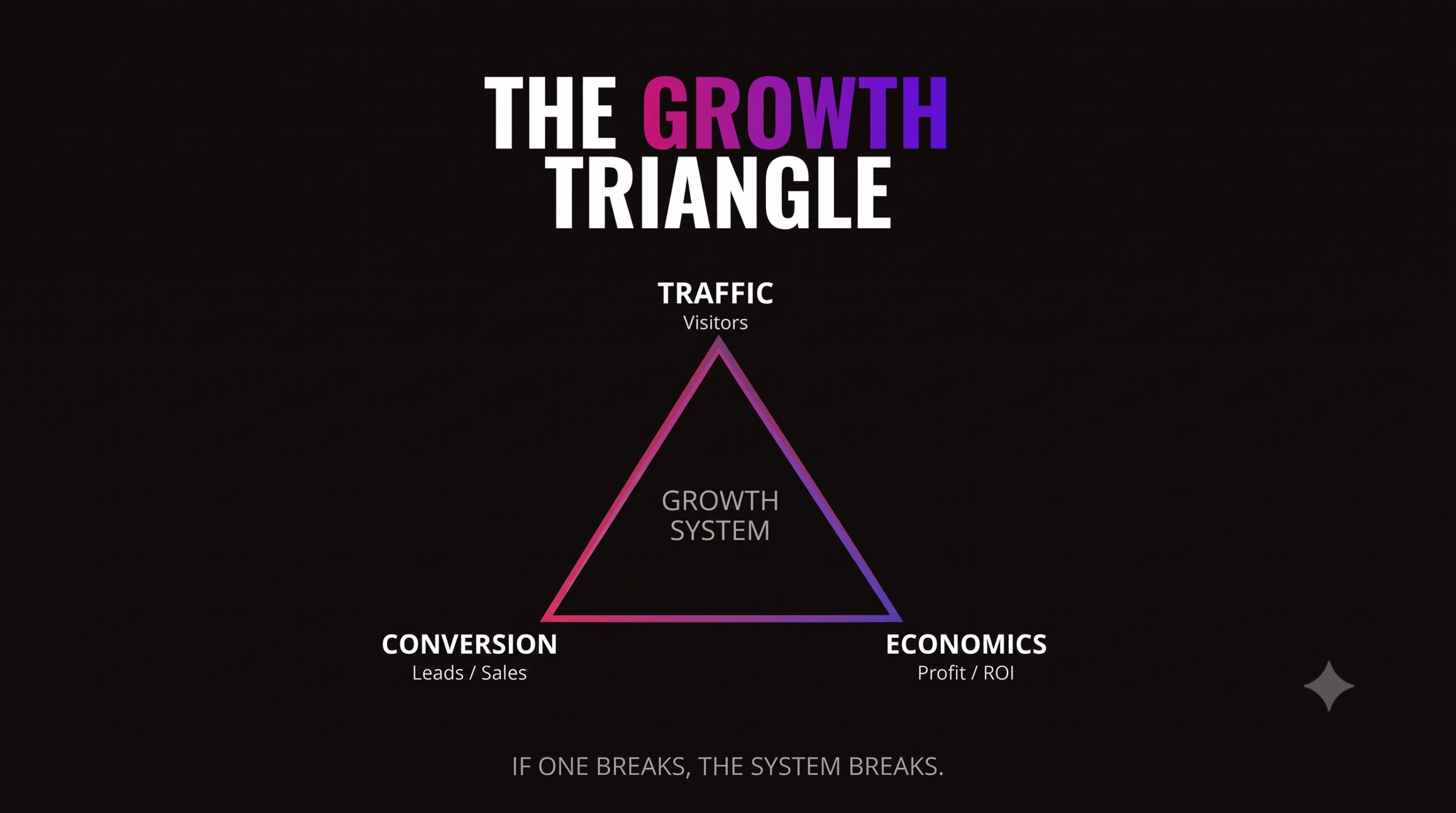
But if it costs $500 to acquire each one and they are only worth $600, your margin is $100 per customer. Break any side of that triangle and the whole thing falls apart.
The question is which side is broken, and you cannot answer that if you never sized the opportunity to begin with.
Problem #8: You have a persuasion problem, not a traffic problem
Most companies in 2026 do not have a traffic problem. They have a persuasion problem.
I was on a website the other week. They had me sold. I was ready to buy. Then they took me through nine different stages to fill in a form, kept asking me questions, and it was nightmarish. I hit the back button. I went to the next competitor, who had a simple two-step process, and I signed up immediately.
The first company lost that deal because they did not design for conversion.
You do not buy better conversion. You design it. You fix messaging clarity and offer strength. You remove friction and build trust signals.
If 100 kids walked past me and only two bought, that was a conversion issue. Same traffic, higher yield comes from making the offer more desirable. For most businesses, that is where the biggest untapped revenue is sitting.
Problem #9: Your economics don’t work
What most teams miss is that it is not about performance. It is about profitable revenue.
If it cost $500 to acquire a customer and the average profit per customer is $600, you made $100.
Spending $500 to make $600 does not fly.
If your cost to acquire is higher than what that customer is worth over time, you do not have a business that scales.
You have a slow bleed that you are not paying attention to.
When each bracelet cost me $0.15 in materials and ten minutes of my time, and I sold it for a quarter, at some point, the economics did not justify continuing. The margin was not worth the effort. So I exited.
Every business has that same threshold. Most just do not calculate it, because they never asked how big the opportunity really was in the first place.
Problem #10: You don’t know your numbers, so you can’t make smart decisions
I ask this question every time I sit with a prospect or an existing client:
What is your average client worth?
And I almost never get a direct number. We start getting into theoretical breakdowns.
You need to know two things to make smart marketing decisions. What a client is worth over their full lifetime. And how long it takes to close them.
Here is why that matters. If you charge $1,000 a month and keep a client for 60 months, that client is worth $60,000, not the $1,000 your monthly report shows. That one number changes how much you can afford to spend to get a customer, how many leads you actually need, and whether a given channel is making you money or just keeping people busy.
Once you have those numbers, you stop guessing. The numbers make the question answerable.
Problem #11: Marketing and sales aren’t aligned, so close rate suffers even when leads come in
The marketing team says we drove leads. The sales team says those leads were not qualified. Usually, marketing did bring in leads and sales did not close them, or there is a misalignment in what each side considers a qualified opportunity.
Here is what alignment looks like in numbers. Take 100 qualified leads and a $50,000 average client value. At a 20% close rate, that is 20 deals and $1 million. Improve to 30%, same 100 leads, and you have 30 deals and $1.5 million.
No additional traffic. No additional spend. Just alignment.
Close rate is rarely just a sales problem. It is a qualification and positioning problem that starts before the sale. Fix it there and the revenue follows.
Problem #12: Your time-to-close is long, which hurts forecasting, cash flow, and momentum
If you are in B2B, you may take six months to a year to close. You can be driving good traffic and converting it into qualified opportunities, but your balance sheet will not show that revenue until the deal closes.
If your cash flow lags and marketing investment compounds slower than expected, forecasting becomes fragile.
Time to close is how long it takes from first contact to signed revenue. It tells you how fast your spend turns into actual money in the bank.
At NVISION, we track time to sale. We know the start date and the sign-off date of every deal. That number is what lets me forecast accurately.
If you do not have it, you cannot predict when spend turns into revenue, and every budget decision becomes a guess.
How Businesses Use Marketing Successfully to Generate Revenue
They treat revenue as the primary purpose of marketing
The businesses that succeed with marketing evaluate every campaign against one question: did this produce revenue?
If yours does not start there, everything after that is off. Start with the question, not with the tactic.
They define what’s realistically winnable before launching campaigns
Before budgets are set, before timelines are agreed to, they answer the question: how much of this market can we actually capture? They size TAM, filter through SAM, and plan around SOM.
If you do that, your budget makes sense and you know exactly where to put it. If you skip it, you are guessing. This one step separates the businesses that grow from the ones that burn capital.
They manage traffic, conversion, and economics as a system
If you double traffic but nobody buys, that is not growth. If everyone buys but you spend too much to acquire them, that is not growth either.
The businesses that grow manage all three as a system because each one affects the others. When they are all working, they build on each other. When one breaks, it drags the rest down. Figuring out which one is broken is the fastest path to revenue.
They build conversion on purpose
Keep traffic the same. Improve conversion from 2% to 4%. You go from 20 deals to 40 deals without spending a single extra penny. You do not buy better conversion. You design it.
You get there by fixing messaging clarity, strengthening the offer, removing friction, and building trust signals. Most businesses have more revenue available in their conversion rate than in any new channel they could add.
They make profitability non-negotiable
If your cost to acquire a customer is higher than what that customer is worth, scaling does not help. It speeds up the losses.
The businesses that grow know their numbers and only increase spend where the economics have been proven. If the math does not work now, volume will not fix it.
They align marketing and sales so close rate improves
When both teams agree on what a qualified opportunity looks like, close rates improve without additional spend.
When they do not agree, leads get wasted regardless of volume. For most businesses, getting marketing and sales on the same page is the biggest win available. It costs nothing and the results show up immediately.
They scale only after performance is proven and repeatable
By the time a business is ready to scale, the experimentation phase should be over. Close rates are predictable. Acquisition costs are stable. You increase spend on what is already working, not on what feels exciting.
I tell clients: ask your teams what has worked in the past 6, 12, or 24 months. There will be a golden nugget in there, something that has been working that you have not doubled down on. That is your first move.
How to Implement Successful Marketing for Your Business
Step 1: Size Your Market and Find the Leaks
After this step, you will know your baseline: how big your market actually is, what each client is worth, how long it takes to close, and where people are dropping off.
That is enough to make your next marketing decision a smart one instead of a guess.
Size up your potential. Work through TAM, SAM, and SOM. Pull your sales from the last 12 months and calculate the averages. Then find the choke points: where are people dropping off? You cannot fix what you cannot see.
Step 2: Fix Conversion and Align Your Teams
After this step, more of your existing traffic turns into revenue without additional spend.
Fix conversion before you scale traffic. If your website takes people through too many steps, simplify it. If your messaging does not speak to your audience, rewrite it.
Make sure marketing and sales agree on what a qualified lead looks like. Then put your energy where your audience actually is. If you sell to senior executives, you are probably not making TikTok videos. You are probably on LinkedIn.
Step 3: Double Down on What’s Working
After this step, you are scaling what is proven instead of experimenting with what is new. That is how revenue compounds.
Ask what has worked. If there is more market opportunity to capture, double down. Do not spread budget across new experiments when existing ones are producing.
The gains stack. And when they stack, that is when marketing stops costing you money and starts making you money.
Want NVISION to Implement This Marketing System for You?
This is the framework we apply across every engagement at NVISION. We have applied it across hundreds of organizations over more than 22 years.
It starts with the question: how much of this market can you realistically capture? Everything else follows from the answer.
Book a free 30-minute strategy session. We will look at your traffic, your conversion, your economics, and your close rate, and tell you exactly where the leaks are and what to fix first.
Find Trusted Digital Marketers Near You |
|
|---|---|